
The Frequency of the Heart
For centuries, the heart was seen primarily as a pump. Today, research suggests it may be doing far more.
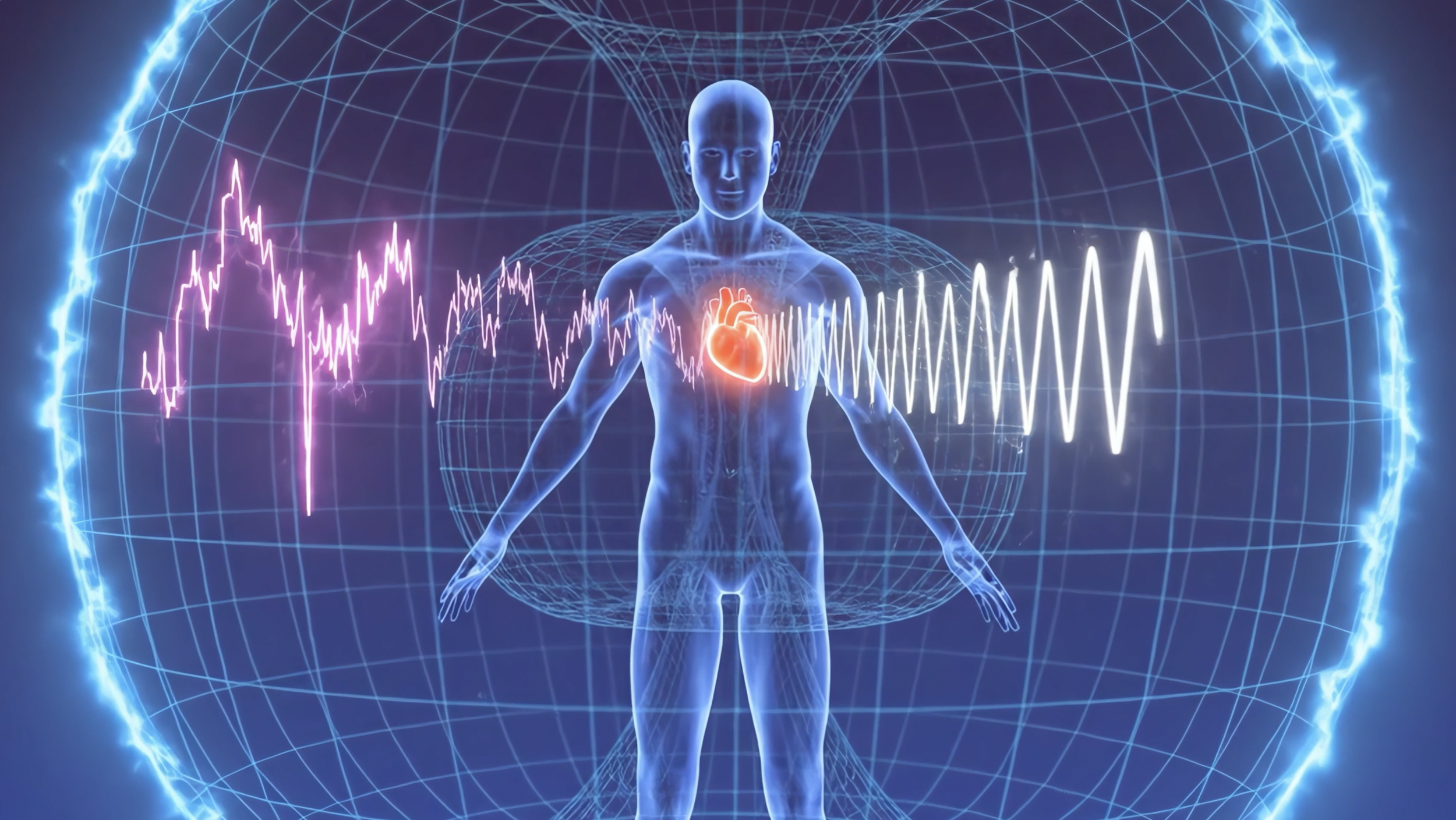
At institutions like the HeartMath Institute, scientists have spent decades studying the relationship between the heart, brain, and the body’s electromagnetic field.
What they’ve found points toward a different understanding of the human system. The heart is not only responding to our emotional state. It may also be helping shape it.
A Field Around the Body
Research has shown that the heart produces the largest measurable electromagnetic field in the body. According to Joe Dispenza, the heart’s magnetic field can extend several feet beyond the body.
At institutions like HeartMath, scientists have been measuring this field for decades. Using sensitive instruments called magnetometers, researchers can detect the heart’s field several feet away, while brain waves can typically only be measured close to the surface of the head.
But it’s not just the size of the field that matters. It’s what the field carries.
The Language of Emotion
Research at HeartMath suggests that the heart’s magnetic field is not random. It contains information. Patterns within the field appear to reflect emotional states.When the body is under stress, the heart’s rhythms become irregular and disordered. When a person experiences emotions like gratitude, compassion, or appreciation, those patterns become more ordered and stable.
This measurable shift is known as heart coherence.
Heart-Brain Coherence
Heart-brain coherence describes a state where the heart and brain begin to operate in sync.
Instead of competing signals, the body moves into a more coordinated rhythm. Breathing, heart rhythms, and brain activity begin to align into smoother, more harmonious patterns.
Research associated with HeartMath has identified a frequency around 0.1 Hz as a key point of coherence. This same rhythm appears in natural systems, including the Earth’s magnetic field. This suggests something deeper. The body’s internal rhythms may not exist in isolation. They may be connected to larger environmental and planetary systems.
Stress, Coherence, and the Body
Stress changes the body’s rhythms.
Irregular heart patterns can influence the nervous system, hormones, and cognitive function. Coherent states appear to create the opposite effect.
Instead of fragmentation, the body begins operating more like an integrated system. This may help explain why emotions like appreciation or compassion often feel physically different from stress or fear. The physiology itself shifts.
Thought and Feeling
The connection between the brain and heart plays a central role in this process. Thoughts create electrical signals in the brain. Emotions generate magnetic signals in the heart. When intention and emotion are aligned, the body enters a coherent state where both systems are working together rather than in conflict.
This is not just a subjective experience. It is measurable.
And in group settings, it may extend beyond the individual. Some research suggests that when groups enter coherent states together, they may generate a more organized and measurable collective field.
The Heart as a Bridge
What emerges from this research is a different way of understanding the body. Not just as chemistry, but as a dynamic electrical system interacting with itself and its environment. The heart, in this view, is not just a pump.
It is a generator. A communicator. A bridge between internal state and external field. And perhaps most importantly, it is something we can influence. Through attention. Through emotion. Through awareness.
Why This Matters
If emotional states influence the body’s rhythms, then learning how to shift those states may have real physiological effects. Practices such as slow breathing, gratitude, meditation, and heart-focused awareness have all been shown to influence heart rhythm patterns. These are simple, accessible ways to begin interacting with the body’s frequency.
The idea is not about forcing change. It is about creating coherence.
A New Perspective
The relationship between emotion, physiology, and frequency is still being explored. Some aspects are well studied. Others remain at the edge of current understanding. But one thing is becoming increasingly clear.
The human system is not static. It is responsive, adaptable, and constantly communicating through signals we are only beginning to fully understand.
And the heart may be one of the most powerful sources of those signals.